
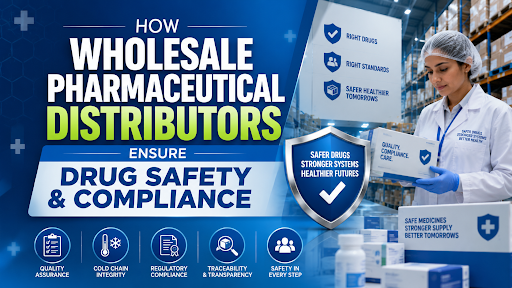
How Wholesale Pharmaceutical Distributors Ensure Drug Safety & Compliance?
Most pharmacies, hospitals, and clinics evaluate distributors on price, availability, and delivery speed. Compliance becomes a secondary conversation — a box checked during onboarding. But when you sign an agreement with a wholesale pharmaceutical distributor, you are not only buying their products. You are absorbing a share of their operational risk. Every shipment that enters your facility carries the compliance weight of the chain that handled it. If that chain has gaps, those gaps now live in your audit trail, your inventory records, and your liability exposure. The question is not whether your distributor is licensed. The question is whether you know exactly what their license does — and does not — protect you from.
When You Buy from a Distributor, You Also Buy Their Risk?
Under the Drug Supply Chain Security Act (DSCSA), dispensers—like pharmacies, hospitals, an d clinics — have to check those product identifiers, and also review the Transaction Information (TI), Transaction Statements (TS), and Transaction History (TH) right at the time they receive the item, not later. The law provides no exemption for buyers unaware their trading partner’s records were incomplete. Ignorance of a distributor’s non-compliance is not a legal defense.
The most common misconception is that FDA registration plus a valid state wholesale license equals end-to-end safety assurance. It does not. Those credentials confirm a distributor was authorized to operate at a point in time — nothing more. They say nothing about whether transaction records are generated accurately, temperature logs maintained in real time, or the distributor’s own trading partners properly verified.
When a pharmaceutical wholesale distributor fails to keep fully complete, interoperable transaction records, it really doesn’t just stay put at their facility. It kind of spills over into the buyer’s paperwork, and then you get these traceability holes that show up later during FDA inspections , state board audits, and even product recalls. And the buyer who picked the lowest bid , without actually checking the compliance infrastructure, has quietly taken on a liability they never talked about or negotiated in the first place.
What “Compliant” Actually Means — And What It Deliberately Leaves Out?
NABP accreditation, FDA registration, and active state licensure confirm a distributor satisfied defined criteria at the time those credentials were issued. These are snapshot standards — they certify past performance against a checklist, not ongoing operational discipline.
A distributor can carry all three credentials and still exhibit:
- Temperature monitoring systems that log data but never automatically flag deviations or alert buyers
- Trading-partner verification workflows that confirm an FDA registration number without assessing whether that partner’s practices meet GDP standards
- Recall notification processes dependent on manual cross-referencing rather than automated, time-stamped buyer alerts
The governing insight is structural: compliance is backward-looking; safety is forward-operating. Regulatory bodies assess what happened during a defined audit window. A genuinely safe distributor engineers against what could happen on any given Tuesday with no inspector present. Buyers who grasp this distinction stop asking “are you compliant?” and start asking “what does your operation look like when no one is watching?”
The Difference Between a License and a Guarantee
No regulatory body — not the FDA, not the DEA, not the NABP — guarantees a distributor’s day-to-day performance between credentialing cycles. A license authorizes. It does not certify quality continuity.
NABP’s Drug Distributor Accreditation is more rigorous than basic state licensure, evaluating facility standards, personnel practices, and distribution controls. But accreditation cycles are periodic, not perpetual. For buyers, this means distributor vetting must function as an ongoing procurement discipline, not a one-time onboarding screen. The credential check opens the conversation. It should not close it.
The Five Due Diligence Questions Every Buyer Should Ask Before Onboarding a Distributor
These are not courtesy questions. Each is a diagnostic designed to separate a distributor with genuine operational depth from one that is paper-compliant and procedurally shallow.
1. “Can you provide Transaction Information and Transaction Statements in a fully interoperable electronic format today — not through a manual workaround?”
The DSCSA’s electronic interoperability requirement has been in enforcement since August 2025. A distributor still relying on manual processes is behind the compliance curve and transferring that exposure to every buyer they serve.
2. “Walk me through exactly what happens — step by step — when your system flags a suspicious order.”
This separates distributors with practiced SOPs from those with theoretical ones. Vagueness signals the protocol exists on paper and stops there.
3. “What is your documented SLA for notifying buyers during a Class I drug recall, and can you show a recent example?”
A Class I recall carries the highest patient risk. A distributor without a defined, tested notification timeline is not a safe operational partner for any pharmacy carrying recalled product in active inventory.
4. “How are temperature excursions logged, escalated, and communicated to buyers — and who holds decision authority on product disposition?”
This surfaces chain-of-custody discipline and the transparency a distributor extends when something goes wrong.
5. “How do you verify a new manufacturer or secondary supplier beyond checking their FDA registration number?”
A rigorous wholesale pharmaceutical distributor describes additional steps — facility review, purchasing history analysis, reference checks — before onboarding any new source into their authorized supplier network.
A distributor that cannot answer these questions with operational specificity is communicating exactly as much as one that can.
How a Rigorous Distributor Operates When No One Is Auditing?
The audit is a test. The operation is the truth.
Operationally rigorous distributors share visible, verifiable characteristics:
- Continuous temperature monitoring with automated deviation alerts sent directly to buyers — not internal-only logs reviewed after the fact
- Rolling trading-partner reviews that reassess authorized suppliers on a defined schedule, not only at initial onboarding
- Internal mock recall exercises that test speed and accuracy of product retrieval, record generation, and buyer notification — with documented results available on request
- Staff-level exception SOPs ensuring every warehouse employee understands the escalation chain when a product cannot be verified — not just the compliance officer
Transparency about operational processes — not credentials alone — is what distinguishes a distributor whose safety posture is real.
Why Independent Distributors Can Offer Compliance Advantages Large Networks Cannot?
Scale is not inherently a safety advantage. Large distribution networks carry more trading-partner touchpoints, more complex sourcing relationships, and longer internal communication chains when an exception occurs. Each added layer is a point where critical information can slow or fail to reach the buyer in time.
An independent, NABP-accredited distributor with a curated, pre-qualified supplier network manages fewer counterparty relationships — meaning tighter chain-of-custody control and faster direct communication during a product hold, recall, or deviation. The compliance advantage is structural: fewer nodes between a problem and the person who needs to know about it.
Reframing the Distributor Decision as a Patient Safety Decision
The product that reaches a patient carries no disclosure of every handling decision made upstream. It arrives as dispensed. If a compromised product entered a pharmacy’s inventory through a distributor with undetected compliance gaps, clean paperwork at the point of sale does not reduce the clinical risk.
Every distributor selection made in a procurement meeting is, functionally, a patient safety decision. The buyer who treats it as a price-and-availability exercise is still making that decision — just without the awareness. Buyers who internalize this reframe ask better questions, set clearer accountability expectations, and choose partners whose operational transparency matches the weight of the products being handled.
Partner with a Distributor That Makes Your Compliance Its Responsibility
Drugzone Pharmaceuticals Inc. is an NABP-accredited, FDA-registered wholesale pharmaceutical distributor licensed across all 50 states, headquartered in Nanuet, New York. Founded by a New York-licensed pharmacist and backed by over 80 years of combined leadership experience, Drugzone operates from a 20,000 sq. ft. temperature-controlled facility with 2,000+ SKUs sourced from 75+ verified manufacturers. Its DSCSA 2025-compliant infrastructure — spanning electronic transaction data exchange, verified sourcing, and controlled cold-chain logistics — protects not just its own operations, but the audit integrity and patient safety obligations of every pharmacy, hospital, LTC facility, and specialty clinic it serves. When you choose Drugzone, compliance transfers in the right direction.
Frequently Asked Questions
- If my distributor is DSCSA-compliant and FDA-registered, am I automatically protected from liability in an audit?
No. Your distributor’s compliance reduces risk but does not eliminate your own obligations. Pharmacies and healthcare facilities must independently verify that Transaction Information, Transaction Statements, and Transaction History are complete and interoperable at the point of receipt. If your distributor’s records are incomplete, that gap surfaces in your audit trail — not just theirs.
- At what point does risk actually transfer in a buyer-distributor relationship?
Risk transfers the moment a shipment crosses your receiving threshold. Once a product enters your inventory, you have implicitly verified the integrity of the transaction records attached to it. If those records are later found inaccurate or missing, liability does not automatically revert upstream. Vetting must happen before onboarding, not after a compliance incident.
- Is NABP Drug Distributor Accreditation meaningfully safer than state licensure alone?
Yes — but with a caveat. NABP accreditation evaluates facility conditions, personnel practices, GDP adherence, and distribution controls — a higher bar than state licensure. However, it operates on a periodic review cycle, not continuous monitoring. A distributor’s actual safety posture between cycles depends entirely on internal operational discipline. Treat accreditation as a necessary qualifier, not a final answer.

Eliza Gordon is a seasoned writer for the health industry dedicated to providing fact-based health information. She sources concise facts from authoritative sources to ensure maximum credibility and shares guidelines to lead a healthy lifestyle.
Related Articles

Multiple Botulism Cases Raise Safety Concerns for Botox Injections
Recently, the sudden spike in botulism cases across the U.S and the U.K. reflects some serious safety concerns regarding Botox treatment. Follow along to explore in detail.
read moreAbout Us

The Healthcare Facts is a blog site that posts regular content on fitness, healthy eating, weight loss, healthy mind and wellness. The aim of the blogs is to encourage people stay fit and healthy physically, mentally and spiritually.
Copyright © 2026 The Healthcare Facts. All Right Reserved.