
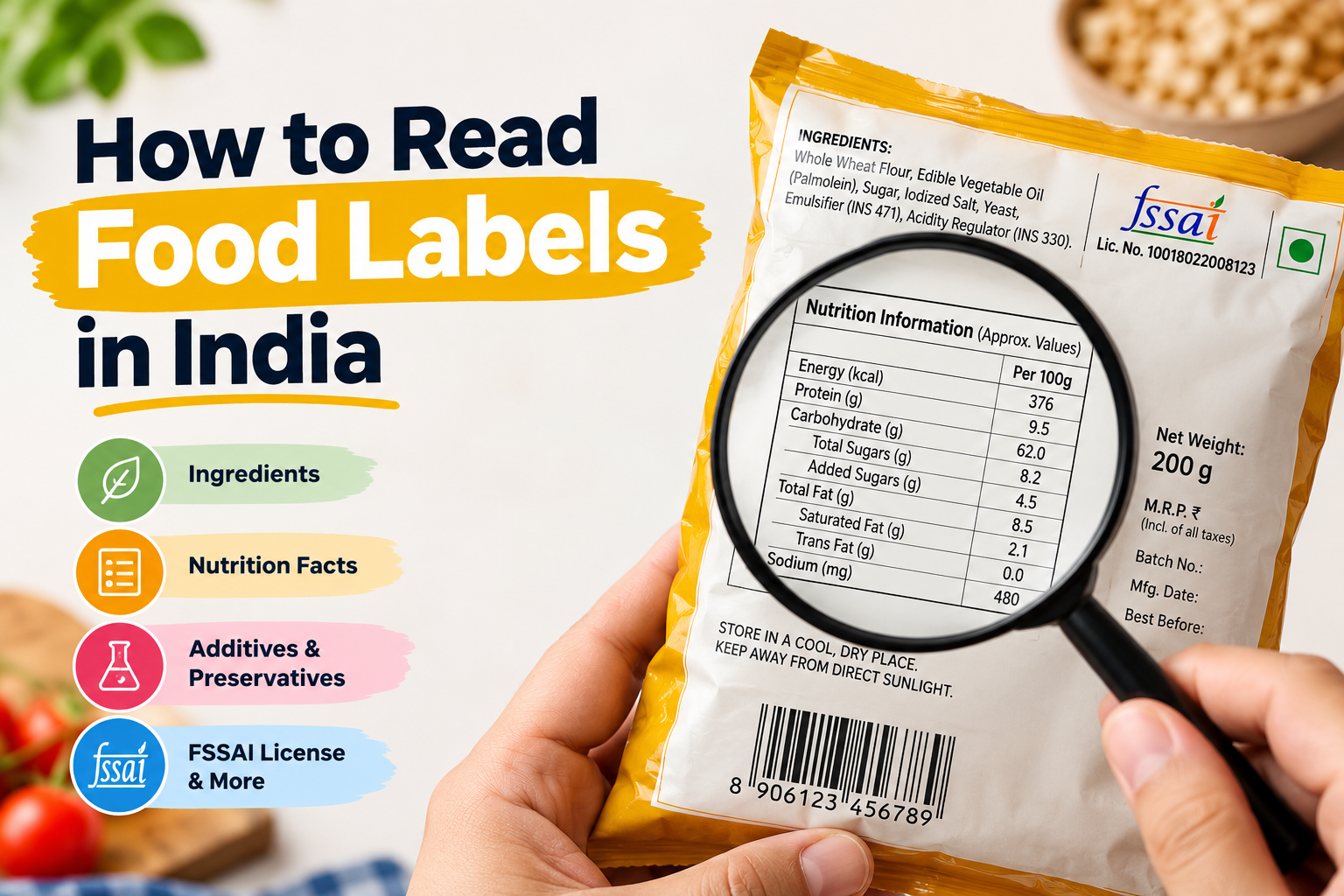
How to Read Food Labels in India: A Practical Guide to Making Informed Food Choices
You walk into a supermarket for “just a few things” and end up holding a packet that promises high protein, natural goodness, multigrain, and no added sugar. Sounds healthy, right? Then you turn the packet around and meet an ingredient list that looks like it belongs in a chemistry textbook.
As a nutritionist, I see this confusion all the time. And honestly, you don’t need to become a food scientist to shop wisely. You just need to know what deserves a closer look.
With packaged foods becoming an everyday part of our shopping baskets, how to read food labels has become an increasingly important conversation. India’s ongoing debate around front-of-pack warning labels has made the issue even more visible. Reuters reported that FSSAI has proposed warning labels for foods high in added sugar, added fat, or salt, although the rules and implementation timeline continue to evolve.
So, let’s turn that intimidating packet into something you can actually understand.
Why Food Label Awareness Matters
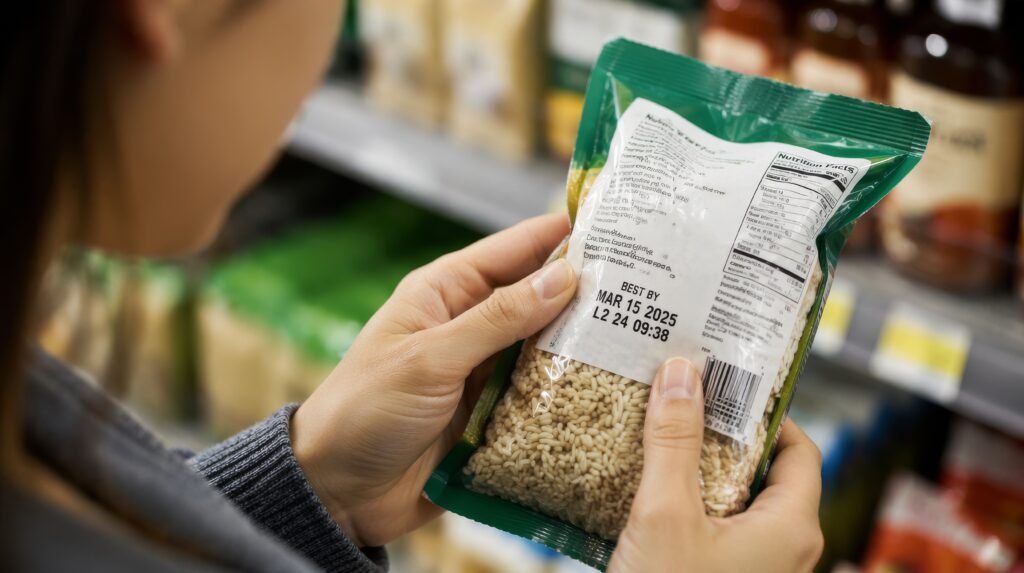
The front of a packet is basically the product’s advertising billboard. The back is where things get interesting.
Labels can tell you what is inside the product, how much you’re eating, its nutritional composition, allergens, dates, and manufacturer information. FSSAI’s labelling regulations have requirements for this information and state that food labels shouldn’t be false, misleading, or deceptive.
That means the label isn’t there merely to occupy the back of the packet. It’s one of your best shopping tools.
What Information Can You Find on a Food Label?
Here’s your quick decoder:
- Ingredient list: Tells you what actually went into the product.
- Nutrition information: Shows nutrients such as calories, protein, carbohydrate, sugars, fat, and sodium.
- Allergen information: Helps you identify specified ingredients that may trigger allergies.
- Net quantity: Tells you how much product is actually in the packet.
- Date information: Helps you check relevant manufacturing, expirty/use-by and best-before details.
- Manufacturer or brand-owner details: Tells you who’s responsible for the product.
Think of it as the packet’s resume. Read the whole thing before accepting its job application.
How to Read the Ingredients List on Packaged Food
If you want to know how to check ingredients in packaged food, start here.
Understand the Order of Ingredients
Ingredients are generally listed in descending order of their composition by weight or volume at the time of manufacture, subject to applicable requirements.
In plain English: the ingredients appearing near the beginning deserve your attention.
Try this at home –
Pick up 2 packets of biscuits. If one starts with refined wheat flour followed by sugar and fat, while another starts with whole wheat flour, you already have useful information before looking at the front-of-pack claims.
That doesn’t make one packet automatically “healthy” and the other “unhealthy.” It simply tells you what the products are primarily made from.
Identify Added Sugars and Other Ingredients
When you’re wondering how to identify added sugar in packaged food, don’t rely only on the giant “healthy” claim on the front.
Check the ingredient list and nutrition panel on food labels in India together.
For example, suppose you’re buying packaged bread. The front says multigrain. Flip it around. If the ingredient list contains refined wheat flour first and smaller quantities of whole grains later, the word “multigrain” suddenly has more context.
Likewise, with a breakfast cereal, don’t stop at the picture of strawberries and almonds. Check how much of the product is actually made up of grains, sugar, nuts, or fruit. For best results, use an app like TruthIn, as explained by FoodPharmer, to check what your breakfast food actually contains.
Ultimately, the trick isn’t to panic every time you see the word “sugar.” It’s to understand how much is present, where it appears in the ingredients, and how much you actually consume.
Understand Food Additives
Additives can sound scary simply because their names are unfamiliar. But “I can’t pronounce it” isn’t a scientific test for whether something is safe.
Food additives can serve functions such as colouring, preserving, stabilizing, or flavoring. FSSAI has specific requirements for their declaration and permitted use.
So don’t automatically label an ingredient as “bad” because its name looks complicated. Look at the product as a whole, and where necessary, check reliable regulatory information.
Understanding Sugar, Fat and Salt in Packaged Food
How to Check Sugar Content
For this dilemma, look at:
- Total sugar
- Added sugar
- Serving size
- Nutritional values per 100 g or 100 ml, where provided
- Similar products or comparison
Here’s a very Indian supermarket example: you’re choosing between 2 flavored yogurts. One has a large protein claim on the front. The other looks more ordinary.
Don’t guess. Turn both around. Compare their serving sizes, protein, total sugar, and added sugar. You may discover that the product shouting about one nutrient also contains considerably more sugar.
That’s why I always tell people—don’t shop by one number.
Why Serving Size Matters
Here’s a sneaky little detail. The nutrition numbers may be based on one serving, not the entire packet.
If one serving is 30 g and you eat 60 g, congratulations—you’ve eaten 2 servings.
Imagine your favorite namkeen packet says one serving is 30 g. You pour some into a bowl while watching cricket, refill the bowl, and then mysteriously discover half the packet has disappeared.
Your stomach knows what happened. The label does too.
How to Compare Two Similar Products
If how to read nutrition labels on packaged food in India feels like homework, use a simple side-by-side comparison.
| Information | Product A | Product B |
| Serving size | 30 g | 30 g |
| Total sugar | 8 g | 4 g |
| Protein | 3 g | 5 g |
| Fat | 6 g | 4 g |
| Sodium | 180 mg | 120 mg |
These are illustrative figures, not measurements of particular brands.
Notice what we’re doing here. We’re not asking which packet is healthy. We’re asking, “How do these 2 products differ?” That’s a much more useful question.
Are Food Marketing Claims Always Easy to Understand?
Words like natural, no added sugar, high protein, multigrain, healthy, and low fat are designed to catch your eye. And they work—that’s why they’re on the packet. FoodPharmer breaks this down thoroughly in his video dissecting marketing gimmicks.
Why Consumers Should Check the Full Label
Take “no added sugar.” It doesn’t necessarily mean “sugar-free.” FSSAI has specific conditions for claims relating to the non-addition of sugars, including requirements concerning naturally occurring sugars.
Or take multigrain bread. “Multigrain” simply tells you that multiple grains are used. It doesn’t, by itself, tell you that the bread is mostly whole grain.
And low fat? It tells you something about fat. It doesn’t immediately tell you about sugar, sodium, calories, or the overall nutritional profile.
This is why understanding food claims means looking beyond the headline. Marketing terms often fuel popular nutrition misconceptions. Learning about common healthy eating myths helps you shop and eat food better.
How to Verify a Product’s Claims
Before you put the packet in your trolley, ask:
- Does the ingredient list support the claim?
- What does the nutrition panel say?
- Is there relevant certification or regulatory information?
- Is credible testing evidence available?
Consider packaged fruit drinks. A picture of mangoes on the front may make you think “mango juice.” But check what the product actually calls itself, its ingredients, and its fruit content percentage.
The same principle applies to “fruit-flavored,” “protein-rich,” “sugar-free,” and similar claims.
FoodPharmer’s Fanta comparison is another useful illustration. His video points to differences between Indian and European versions in ingredients, coloring, orange content, and sugar. The point for you isn’t to assume that one country’s version is automatically better. It’s to read what’s actually written on the bottle.
What is Food Adulteration and Why Does Transparency Matter?
Understanding Food Adulteration
Food adulteration in India can involve contamination, substitution, or other changes that compromise food quality, safety, or required characteristics. This is especially critical when eating street food during summer.
But here’s an important distinction: hearing that one product or sample failed a test doesn’t automatically mean every product from that brand is adulterated. Context, sample, and method matter.
Yet, there are enough cases of criminal adulteration in India where the lack of oversight by official channels matters. It raises an even bigger, more bureaucratic question.
Why Laboratory Testing is Important
Labels tell you what a manufacturer declares about a product. Laboratory testing can answer specific questions about what’s present in a particular sample. Alongside testing, emerging solutions like the impact of blockchain technology on food distribution are helping track supply chains from farm to table.
Depending on the test, laboratories may analyze products for contaminants or verify specific nutritional or compositional characteristics.
FoodPharmer’s paneer investigation demonstrates this difference. Rather than stopping at the packaging, the investigation uses laboratory testing to examine paneer and analog products and discusses differences in protein and micronutrient content.
This is where food testing can add another layer of information.
The Role of Independent Product Testing
When looking at independent food product testing, don’t just jump to the big red “FAIL” on your screen. Look underneath it. Check:
- How was the sample selected?
- What exactly was tested?
- Which laboratory conducted the test?
- What methodology was used?
- What were the pass/fail criteria?
- What limitations did the test have?
Trustified says he independently purchases products and sends sealed samples for blind laboratory testing. He also says the testing may cover areas such as heavy metals, chemicals, and amino spiking, depending on the product and testing parameters.
And that final qualification is important. No single test checks for everything.
How Food Testing Platforms Help Consumers
What is Blind Product Testing?
Simply put, the laboratory isn’t supposed to be influenced by knowing which result the tester wants. It’s a useful concept because testing should be about measuring the sample, not providing a predetermined story.
Why Test Results Should Be Read Carefully
When you see a viral test result, take a breath before forwarding it to your family WhatsApp Group. Check:
- Product and batch information
- Testing parameters
- Laboratory details
- Testing date
- Pass/fail criteria
- Limitations of the test
Trustified’s videos on whey, Hajmola, Britannia NutriChoice, and milk show how consumer testing can investigate questions that a label alone cannot answer.
What Consumers Should Consider Before Buying a Product
Use testing results alongside the label, nutrition information, regulatory information, and your own dietary needs.
In other words, don’t outsource your entire grocery list to one Instagram Reel.
The Growing Awareness of Food Labels in India
FoodPharmer’s work is part of a larger conversation around food transparency and label awareness in India.
His Fanta comparison encourages consumers to examine formulations. His Maggi video asks consumers to think about the difference between health-oriented marketing and the actual ingredient profile. His oil-board video brings nutrition education into schools and workplaces. His paneer investigation adds another piece to the puzzle—sometimes, you need testing to answer questions that a label cannot.
The common thread is simple. Ask questions, then look for evidence.
Social media can make us curious. The labels, regulations, and credible testing help us investigate that curiosity.
7 Practical Tips for Making Informed Food Choices
- Read the ingredient list. Start with the first few ingredients.
- Check the nutrition information. Look at sugar, fat, sodium, and protein.
- Understand the serving size. Know how much you actually eat.
- Compare similar products. Don’t compare apples with instant noodles.
- Examine health claims carefully. A shiny claim isn’t a complete nutrition assessment.
- Review relevant product testing. Look at the sample, laboratory, methodology, and limitations.
- Consider your own dietary needs. If you have allergies, medical conditions, or specific nutritional requirements, speak with a qualified healthcare professional. Eat based on your long-term wellness goals.
Reading food labels isn’t about becoming suspicious of every packet in your kitchen. It’s about becoming a little harder to impress.
A smiling “high protein” badge shouldn’t end the conversation. Neither should a scary ingredient name or a viral test result.
Look at the ingredients. Check the numbers. Understand the serving size. Compare similar products. And when someone makes a dramatic claim about food, ask the most useful question of all:
What does the evidence actually show?
This small habit can make you a much more informed shopper—and reduce your confusion at the grocery aisle.
Have health insights to share? Head to our Write For Us: Food Blog page and submit your healthcare information blog to our growing community!
FAQs
1. What is the importance of reading food labels?
Reading food labels helps you see what you’re actually eating. It reveals hidden sugars, preservatives, and allergens, helping you make healthier choices and avoid harmful ingredients.
2. How do I check sugar content on a food label?
Look at “Total Sugars” and “Added Sugars” under the Nutrition Facts. Check the ingredient list for hidden sugars like high-fructose corn syrup, maltose, cane juice, or dextrose.
3. How can consumers verify food product claims?
Compare bold front-of-package claims (like “100% Natural”) with the back ingredient list and nutrition table. Look for certification logos from official regulatory bodies like FSSAI.
4. Does a food product passing a laboratory test guarantee that it is healthy?
No. Lab tests only confirm the food is safe to eat and matches its label. A product can pass lab safety tests and still be full of unhealthy sugars or fats.
5. Why is transparency important in food testing?
Transparency builds trust. Honest lab testing ensures brands don’t hide harmful ingredients or make misleading health claims, letting consumers know exactly what they are putting into their bodies.
6. What should I check before buying packaged food?
Check the expiry date, serving size, added sugars, sodium, and trans fats. Skim the ingredient list—fewer, recognizable ingredients usually mean a healthier choice.

Eliza Gordon is a seasoned writer for the health industry dedicated to providing fact-based health information. She sources concise facts from authoritative sources to ensure maximum credibility and shares guidelines to lead a healthy lifestyle.
Related Articles

Healthy Eating: Do I Need Pre-Workout Supplements or Not?
All of us have seen commercials showing the use of supplements and pre-workouts and how they can help us gain a better physique. But many of us also tend to…
read more
7 Key Food Practices for Optimal Health and Well-Being
Are you ready to welcome 2024 with better health and lifestyle practices? Well, making a year most opportune instead of your eating habits is not impossible. You just need the…
read more


Copyright © 2026 The Healthcare Facts. All Right Reserved.