
What are the trends in vitamin E prices with respect to deficiency, dietary requirements and supply of markets for Supplementation.
Vitamin E for the majority of us is an up close, mostly-weathered friend. A cereal box line, a multivitamin capsule serving, or a serum that would do wonders to your body right? Vitamin E is nearly found in a wide range of impact, so on the talents it is normal that you should be getting a greater share and for certain even screen Vitamin E Price Trend to time your pallid solution once more. A better question would be what does your body actually need, and whether or not it is already on your plate. Vitamin E is a fat-soluble antioxidant that exists in most diets so average meals are sufficient for many healthy individuals.
What is Vitamin E and the Need for the Human Body?
More correctly, “Vitamin E” is a term encompassing eight related compounds. Only one
(alpha-tocopherol) is accepted as fulfilling human requirement, which is why dietary guidelines are based upon it. Because it is fat-soluble instead of water-soluble (like B vitamins), the body keeps it in cell membranes and fatty tissue rather than flushing it out daily.
Its main job is antioxidant. While our cells naturally produce free radicals during metabolism, Vitamin E plays a pivotal role in protecting cell membranes from such damage. It was also meant to promote immunity and daily cellular functionality.
That’s the solid part. Research is scant when it comes to claims about younger skin or hair — as a man, I do not vulgarly evaluate hair growth against claims of thicker tresses — or heart disease and cancer prevention, so caveat emptor.
Well, how much vitamin e do you require on a daily basis?
Requirements shift with age. A daily allowance of 15mg of alpha- tocopherol is recommended for adults and pregnant women. Women who are breastfeeding 19 mg The amount dropped drastically: 6 mg for toddlers, 7 mg between four and eight years old, and 11 mg from nine to thirteen.
The Dietary Reference Intakes — or DRIs (chapter 2) provide numbers that describe what is sufficient for most healthy individuals in a group. They aren’t a personal prescription. A person with a digestive condition or limited diet may need something different, and that is a discussion to have with a doctor or dietitian.
Best Vitamin E-Rich Foods
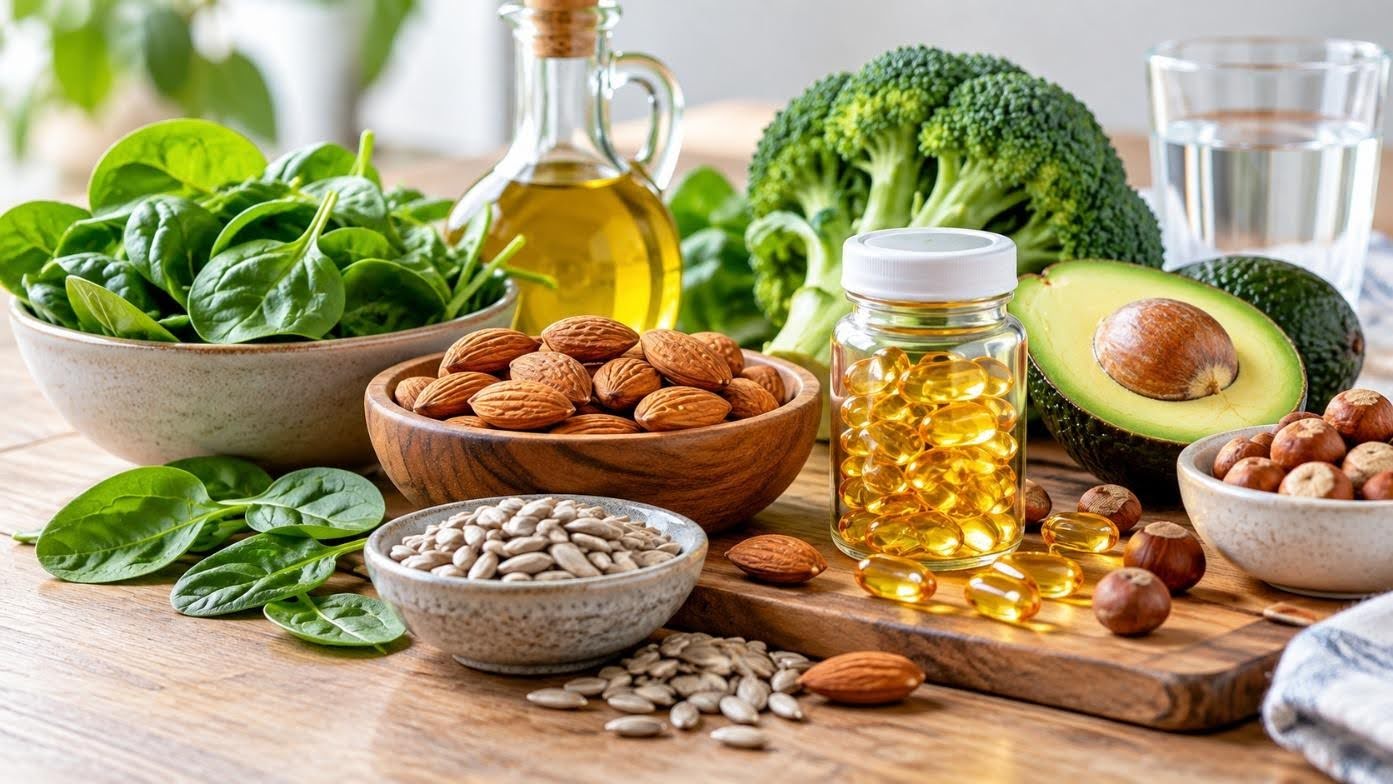
Nuts and seeds win here. Sunflower seeds are in fact a good bet and a handful of some almonds, hazelnuts or peanuts can go along way towards the daily goal. With the exception of a few people who have been responsible for filling their cupboard with wheat germ oil, it ranks higher than almost anything else by spoonful. Sunflower and safflower oils are much more readily available. Spinach and broccoli have these in smaller amounts, but they all add up over a week, and many cereals and spreads are fortified — so check the label.
You don’t need a meal plan for any of this. Add sunflower seeds to a salad, mix chopped almonds in to porridge, wilt spinach with into soup or alternate your cooking oil occasionally. You can also fill-up on fibre and other nutrients that no capsule can match.
Vitamin E Deficiency: Who Is At Risk?
However, true deficiency is rare in healthy individuals. A little below for a couple of weeks will not do it.
However, we are what we eat only works if fat is being absorbed too; vitamin E needs dietary fat to enter the body. This can affect anyone from someone with Crohn’s disease or cystic fibrosis to people with rare inherited disorders that affect fat absorption or the metabolism of Vitamin E, as well as premature babies and in particular those with extremely low birth weights, which neonatal teams are aware of.
When you feel tired or run down, it is not an indication that we are low on. Don’t take a guess, because there are many things that lead to that.
Signs of vitamin E deficiency include:
In deficiency, you mainly see it in the nerves and muscles. Some reported effects are nerve damage, weakness in the arms or legs and loss of control (coordination) and balance as well as vision problems. The immune response could also come down.
Each of these has alternate, far more probable explanations. Your doctor can carry out tests to identify the true cause rather than leaving you in the position of self-diagnosis — numbness or an unsteady walk must be checked.
You Said: Vitamin E supplements — When do they help?
Supplements are only Vitamin E as a stand-alone vitamin or it has one ingredient in a multivitamin. The gap in dose is large. Single-nutrient capsules can contain hundreds of times more than daily requirements, while most multivitamins are moderate in comparison.
Forms vary too. Labels for natural Vitamin E list it as RRR-alpha-tocopherol (or d-alpha) and those for the synthetic versions as all-rac or dl-alpha. Natural form is more bioavailable so two products with the same mg number does not necessarily have the same effects in the body.
It is reasonable to turn to a supplement when food alone does not suffice or when a clinician identifies a particular need, such as a fat-absorption disorder. If not, then going high has little reason.
Harmful Overdose: Can Excess Vitamin E Be Hazardous?
Vitamin E in food levels is not an issue. No one ever went overboard on the almonds and spinach.
High doses are another story. Vitamin E affects blood clotting, which is important for people taking medications such as warfarin or aspirin (anticoagulants or antiplatelet medicines) because it can increase the chance of bleeding. For most adults, the upper limit from supplements is 1,000 mg a day; and some large studies have not been so reassuring that it remains entirely safe in high doses for the long-term. That research is still ongoing.
There’s no need for alarm. Vitamin E at high doses is not for everyone, and anyone on blood thinners or who are being treated medically should be advised by a doctor or pharmacist before taking this supplement.
Food First or Supplements First?
For the majority of us food comes first. A healthy diet provides Vitamin E, plus fibre, minerals and other compounds that are difficult to replicate in a single pill. And a larger number on the label doesn’t always mean added benefits. Supplements should only fill a real gap, not be used as blanket insurance- anything above what your body needs has no proven return.
Trends of Vitamin E Price (Source: 2021-2028) Per USD Lookout at Worldwide Consumer Health No-eBooks
Cost matters, of course. For example, Vitamin E Price Trend can affect how products are designed or positioned on the shelf and what gets into a shopper’s basket for consumers watching their budgets.
But price is a very bad proxy for health. There is no worse than a cheap capsule and by the way there is no better than an expensive one. Ask first if you need a supplement at all, look for formulation/ dose and quality subsequently, with drug interactions with your medications as the last entry. That’s where a pharmacist comes into play.
Incorporating Vitamin E Into Your Overall Diet
When you have a consistent habits in place, here is what else matters:
• Include nuts or seeds in breakfast, salads or as snacks
• Store green vegetables like spinach and broccoli regularly
• Use appropriate vegetable oils, and use them in rotation
• Stop depending a single superfood
• Avoid high-dose supplements unless prescribed by a doctor
Conclusion
As an antioxidant, vitamin E works silently behind the scenes protecting cells and supporting immune function. Deficiency is uncommon in healthy individuals and typically associated with fat malabsorption. In general, a mixed diet covering all the necessary nutrients usually supplies all that individuals require from their food and supplement use should be related only to situations where there is an obvious motive. Therefore, donât let it be the price tag that dictates your choice, or how many grams is on that label when you look for Vitamin E Price Trend next year; Let your health needs do all the talking.

Eliza Gordon is a seasoned writer for the health industry dedicated to providing fact-based health information. She sources concise facts from authoritative sources to ensure maximum credibility and shares guidelines to lead a healthy lifestyle.
Related Articles
Everything You Need to Know About Smart Insulin Pens for Diabetes Management
Introduction Insulin pens have long been a practical and well-liked method of delivering insulin to patients with diabetes. But, as technology develops, so do the tools offered to assist in…
read more
Smartphone Detox! 6 Powerful Morning Rituals to Do Before Checking Your Phone
The advancement of technologies has brought about radical changes in every other sector of business. But what has changed significantly, is our lifestyle! Unlike the earlier days, the first thing…
read moreAbout Us

The Healthcare Facts is a blog site that posts regular content on fitness, healthy eating, weight loss, healthy mind and wellness. The aim of the blogs is to encourage people stay fit and healthy physically, mentally and spiritually.
Copyright © 2026 The Healthcare Facts. All Right Reserved.